Installing Configurations
The first stage is designed to automate the deployment and configuration of dependent objects for the Smart EDR module. Configuration is performed using the utility make_smart_edr.py. The utility is provided in the smart_edr_ko_maker package and located in the bin directory. The utility performs the following tasks:
- Deployment of knowledge objects (
Smart Monitorentities) - Creation of index templates
- Creation of indexes
- Deployment of ISM (Index State Management) policies
- Loading rules from a CSV file
Requirements
- Python 3.x
- Installed dependencies:
requests,urllib3 - Access to the
Smart Monitorcluster with administrator credentials
Utility Structure
The script contains the following directory structure:
./
├── data/               # Main directory with configurations
│ ├── sm_*/             # Directories with Smart Monitor entities (starting with sm_)
│ ├── index_templates/  # Index templates
│ ├── indexes/          # Index configurations
│ └── ism_policies/     # Index state management policies
└── lookups/
└── rules.csv           # CSV file with rules
File Formats
Index settings (indexes) and policies (ism_policies) are for demonstration purposes and must be adjusted to meet installation requirements regarding data rotation and replication configuration.
Smart MonitorEntities (insm_*directories): JSON files with metadata in the_metafield and a unique identifier- Index Templates (
index_templates):{"name": "template_name","index_template": {// template configuration}} - Indexes (
indexes):{"index_name": {// index configuration}} - ISM Policies (
ism_policies):{"policy": {"policy_id": "policy_name",// remaining configuration}} - Rules (
rules.csv): Current list of threat detection rules forBI.ZONE EDR
Installation Sequence
1. Running Configuration Installation
Installation is performed by running the utility make_smart_edr.py:
python make_smart_edr.py --sm_host <host> --sm_user <user> --sm_password <password> [--sm_port <port>]
Command line parameters:
| Parameter | Required | Type | Default Value | Description |
|---|---|---|---|---|
--sm_host | Yes | str | - | Smart Monitor host (one of the cluster nodes) |
--sm_port | No | int | 9200 | Smart Monitor port |
--sm_user | Yes | str | - | Username |
--sm_password | Yes | str | - | User password |
Example execution:
python make_smart_edr.py --sm_host open-search-host-1.my_company.ru --sm_user admin --sm_password securepassword --sm_port 9200
2. Verifying Configuration Application
-
In the
Index Policiessection (Main Menu-Settings-Index Management-Index Policies), the policybizoneis displayed: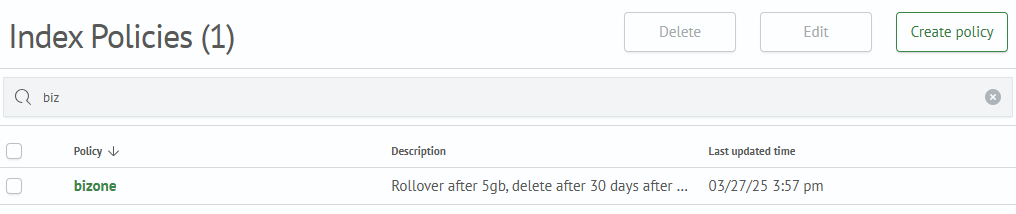
-
In the
Managed Indexessection (Main Menu-Settings-Index Management-Managed Indexes), the module indexes managed by the policybizoneare displayed:
-
In the
Templatessection (Main Menu-Settings-Index Management-Templates), the module templates are displayed:
-
In the directory list
Directory List(Main Menu-Lookup Manager-Directory List), the module directories are displayed:bizone_alert_settingdim_bizone_hostdim_bizone_ruledim_bizone_tasklink_bizone_alert_severity_incident_severity
-
The
dim_bizone_ruledirectory contains a list of threat detection rules